Showing posts with label partial priority. Show all posts

Thursday, 2 February 2017

G 1/15 - The Wait is Over

Back in 2011 I wrote about a potential problem that had been identified to do with priority and EP divisional applications. This problem was confirmed a couple of years later, after which I had a think and came up with a solution. This turned out to be similar to a solution that was considered by the EPO Boards of Appeal in T 1222/11. This was not, however, the end of the story.

The problem, put simply, is that if a European application claims an invention more broadly than is disclosed in a priority application, can partial priority be allowed for what is disclosed in the priority application. If not, then the priority application, if it also publishes as a European application, becomes A54(3) prior art and knocks out the claimed invention. If partial priority is allowed, then the problem goes away (for reasons given here). The Enlarged Board in G 2/98 set out a proviso regarding when partial priority would be allowed under A88(2), which was only if it gave rise to a "limited number of clearly defined alternative subject-matters" (point 6.7). The meaning of this has been argued over for the past few years and a referral was made in August 2015 to the Enlarged Board in T 557/13, which asked the following question:
1. Where a claim of a European patent application or patent encompasses alternative subject-matters by virtue of one or more generic expressions or otherwise (generic "OR"-claim), may entitlement to partial priority be refused under the EPC for that claim in respect of alternative subject-matter disclosed (in an enabling manner) for the first time, directly, or at least implicitly, and unambiguously, in the priority document?
The referral, which was numbered G 1/15, generated a lot of interest, as evidenced by the number of amicus briefs filed, as well as the number of comments received on this blog. Most of the briefs recommended a 'no' answer to question 1, which would cause the problem to go away. Following a hearing in June last year, the Enlarged Board issued an order that gave the following answer to the question:
Under the EPC, entitlement to partial priority may not be refused for a claim encompassing alternative subject-matter by virtue of one or more generic expressions or otherwise (generic "OR"-claim) provided that said alternative subject-matter has been disclosed for the first time, directly, or at least implicitly, unambiguously and in an enabling manner in the priority document. No other substantive conditions or limitations apply in this respect.
As far as I could see, this made the problem go away. There would no longer be any issue over partial priority and possible collisions between a priority document and a European application. Simply answering the question, however, was not the full story. The Enlarged Board has now issued their full reasoned decision, which has just appeared on the EP register here.

The decision goes over all of the arguments put forward along the way, which regular readers will already be well aware of (see the links above to previous posts). What the key question concentrates on is what was meant in G 2/98 by "a limited number of clearly defined alternative subject-matters", and how this could be aligned with the EPC and with the famous FICPI Memorandum that apparently expressed the legislative intent behind A88(2). I have tried to make it clear on this blog that the examples in the Memorandum must be consistent with any interpretation of A88(2), and partial priority should be assessed accordingly. Others, including the respondent in G 1/15 have effectively argued that this does not need to be the case.

The reasoning in G 1/15, as you would expect, starts from basic principles of priority, and develops towards the principles of partial and multiple priorities, leading up to the Memorandum, which defined examples where multiple priorities should be allowed in a single claim. The Enlarged Board thankfully make it quite clear that the Memorandum is indeed consistent with A88 and the Paris Convention, and then lead up to the inevitable consequence that the proviso in G 2/98 "cannot be construed as implying a further limitation of the right of priority" (point 5.3). This is enough in itself to reach a 'no' answer to question 1, but the Enlarged Board go on to lay out in clear terms how partial priority should be assessed. This is laid out at the end of the reasons for the decision, at points 6.4 to 6.7, which state:
In assessing whether a subject-matter within a generic "OR" claim may enjoy partial priority, the first step is to determine the subject-matter disclosed in the priority document that is relevant, i.e. relevant in respect of prior art disclosed in the priority interval. This is to be done in accordance with the disclosure test laid down in the conclusion of G 2/98 and on the basis of explanations put forward by the applicant or patent proprietor to support his claim to priority, in order to show what the skilled person would have been able to derive from the priority document. The next step is to examine whether this subject-matter is encompassed by the claim of the application or patent claiming said priority. If the answer is yes, the claim is de facto conceptually divided into two parts, the first corresponding to the invention disclosed directly and unambiguously in the priority document, the second being the remaining part of the subsequent generic "OR"—claim not enjoying this priority but itself giving rise to a right to priority, as laid down in Article 88(3) EPC.

This also corresponds, logically and exactly, to the scheme described in the Memorandum (see point 5.2 above): "If a first priority document discloses a feature A, and a second priority document discloses a feature B for use as an alternative to feature A, then a claim of the application directed to A or B will in fact consist of two distinct parts A and B respectively, each complete in itself...", and further: "... it would be appropriate to claim a partial priority in situations corresponding to the "OR"-situation under "Multiple Priorities", the European patent application itself taking the place of the second priority document".

The task of determining what is the relevant disclosure of the priority document taken as a whole, and whether that subject—matter is encompassed by the claim in the subsequent application, is common practice in the EPO and among practitioners of the European patent system and as such should not pose any additional difficulty. Nor does it create uncertainty for third parties, as argued by the respondent and in some amicus curiae briefs. Although it can be a demanding intellectual exercise, the decisions reached in cases T 665/00, T 135/01, T 571/10 and T 1222/11 all show that it can be carried out without any need for additional tests or steps.

From this analysis it follows that the assessment of entitlement to partial priority right does not show that any additional requirements are needed.

Just to make it clear, here is a simple flowchart I have created that defines the process to follow when considering whether partial priority should be allowed.
It should go without saying, but I'll say it anyway, that this is what I have been arguing in favour of all along. It should also go without saying that this decision really does put the final nail in the coffin for poisonous divisionals and poisonous priority. Conventional best drafting practice is still acceptable, and we can carry on as before.

Wednesday, 14 December 2016

Confusion around G 1/15 & conceptual splitting

Since I reported a couple of weeks ago about the order issued by the Enlarged Board in G 1/15, there have (at the last count) been 69 comments on the post, which for me is quite a lot. There is a similar, though not quite as lengthy, discussion on the IPKat here. It seems that the EB's order has not yet settled the issue around partial priorities, and there remain some questions about how it should be interpreted. We should, of course, get some clarity once the reasoned decision comes out. For now though, there seems to be quite strong disagreement among some commenters about how to assess partial priority.

The disagreement seems to boil down to whether conceptual splitting of a generic OR type claim can result in different priorities for different parts of a generic claim. Some anonymous commenters have said that this cannot be correct, as it cannot be right to assign a priority to a part of a claim that has not been disclosed. Others, however, have said that conceptual splitting is not even needed, since the only requirement is based on what is disclosed in the priority document. My personal view is that the conceptual splitting approach makes more sense, and avoids problems with Article 4C(4) of the Paris Convention, even though it does result in assigning a priority date to a part of a generic claim that is not literally disclosed in a priority document. It is plausible that the EB could come to a different interpretation, although in my view this interpretation is already covered by the words "at least implicitly" in the order.

The issue can probably be best explained by reference to one of the examples in the FICPI memorandum which, as you will recall, was the basis for the decision on partial priorities in G 2/98 and which was totally ignored by decisions from the boards of appeal that went down on the side of literal interpretation of point 6.7 (the "limited number of clearly defined alternatives" bit). The example reads as follows:
b) Broadening of range (temperature, pressure, concentration, etc.).
     Let us assume that a first priority document discloses a temperature range of 15-20° and a second priority document discloses a temperature range of 10-25°. 
     If multiple priorities for one and the same claim are allowed, it will suffice in the European patent application to draw up a claim directed to the temperature range 10-25°. 
     If multiple priorities for one and the same claim are not allowed, the applicant will have to draw up two parallel claims, one directed to the temperature range 15-20° and enjoying the first priority, and another claim directed to the temperature ranges 10-15° or 20-25°, which claim will then enjoy the priority of the second priority document which was the first one to disclose these temperature ranges. 
It should be clear from this example that there is no need to have literal basis for the ranges 10-15° and 20-25° in the second priority document (let's call it P2) to allow priority for these portions to be validly claimed in the later filed European application (let's call it EP). This, to me at least, suggests that the conceptual splitting approach is correct, where priority for the narrow range of 15-20° is from the first priority document (P1) and for the other parts of the range from P2.

I would guess that the reasoning in G 1/15 will need to go over in detail each of the examples in the memorandum (which G 2/98 did not) to establish clearly what they mean by assigning partial priorities. Unless they do, the argument about whether conceptual splitting is allowed or not will continue to rumble on. My prediction, for what it is worth, is that they will go over each of the examples, and find that conceptual splitting is a necessary feature of assigning partial priorities to a generic OR type claim, particularly in cases where priority is claimed from more than one document, such as in the example above. I might, however, be wrong.

Wednesday, 30 November 2016

G 1/15 - The answer is NO

As I mentioned in my report of the oral proceedings back in June this year, the Enlarged Board in the case of G 1/15 (partial priority) promised that a decision would be made by November this year. True to their word (but only just), an order has just appeared on the EPO register today, which is dated yesterday. The order states in full:
Under the EPC, entitlement to partial priority may not be refused for a claim encompassing alternative subject-matter by virtue of one or more generic expressions or otherwise (generic "OR"-claim) provided that said alternative subject-matter has been disclosed for the first time, directly, or at least implicitly, unambiguously and in an enabling manner in the priority document. No other substantive conditions or limitations apply in this respect.
As readers may recall, this is a response to the first question referred to the Enlarged Board, which was:
Where a claim of a European patent application or patent encompasses alternative subject-matters by virtue of one or more generic expressions or otherwise (generic "OR"-claim), may entitlement to partial priority be refused under the EPC for that claim in respect of alternative subject-matter disclosed (in an enabling manner) for the first time, directly, or at least implicitly, and unambiguously, in the priority document?
In other words, the answer to question 1 is a clear "no". All the other questions were dependent on question 1 being answered in the affirmative, so they now all fall away and need not be answered.

No reasoning has yet been provided behind the order, but this will apparently be issued "as soon as possible", according to the accompanying letter to the EPO president. For now, we can at least be satisfied that the problem of poisonous priority and poisonous divisionals has finally been laid to rest and the flawed case law from the technical boards, as well as in some court decisions (such as this one, which I wrote about here), can be set aside.

Just for the record, I would like to say that I was right all along.

Tuesday, 12 July 2016

Partial Priority - An Alternative View

I have written a lot about partial priority over the past few years (to see all of my posts on the subject, click here), and have always allowed conflicting views to be expressed about the subject, for example in various comments on the subject as well as in this post that expresses a view opposed to my own. The discussion to date has, however, been largely about which side should be taken on the issue of whether partial priority should be allowed for a generic claim, i.e. whether a broad or narrow view should be taken, and always within the framework of the EPC and associated case law. This will, of course, determine the outcome of the currently pending G 1/15 case. There are, however, other perspectives that can shed different light on the subject, one of which has been recently published in epi Information.

The article, titled "The History of Partial Priority System of the Paris Convention", by Kazuo Shibata, a Principal Examiner at the Japan Patent Office, goes through the long history of claiming priority for patent applications, going back to the Great Exhibition of 1851 in London. The author then provides details of the various legal developments, and reasoning behind them, that occurred throughout the world up to the establishment of the European Patent Convention in 1973. A key theme of the article, and what appears to be a favourite subject of the author, is what is described as the "umbrella theory" of priority (illustrated by the picture here, taken from the article). This theory, which apparently originated in Germany, was intended to protect an application from being affected by disclosure of the content of its priority document if it covered a combination of features that included subject matter in the priority document. Interestingly, this protects a combination of A+B as well as A OR B from being attacked by disclosure of A in the priority document.

As the author notes, umbrella theory has not been widely taken up, and appears now to be inconsistent with UK and EPO case law. It does, however, provide an interesting different perspective on the question of whether an invention can enjoy partial priority. The author ends with a scenario that he asks the reader to consider, which is similar to some of the scenarios considered in G 1/15. I my view, the scenario makes sense whether the broad view of partial priority is taken or the umbrella theory view is taken, but the author does not yet have an answer himself. I wonder if anyone else can take a view? Is umbrella theory simply outdated and no longer relevant, or does it have a part to play?

Tuesday, 7 June 2016

G 1/15: The wait is nearly over

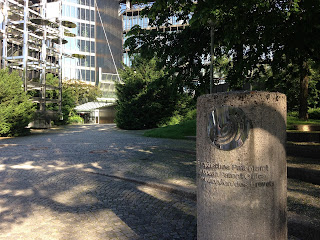
The EPO Isar building in Munich on a lovely sunny day. 
As I mentioned in an earlier post a couple of months ago, I arranged to get out of the office to attend the oral proceedings for the Enlarged Board (EB) case of G 1/15 on partial priority that were scheduled for 7 & 8 June 2016. As it turns out, the second day is not now going to be needed, because the EB concluded the proceedings at just before 3pm today, following just a few short hours of submissions and brief discussions from each side.

Although the EB did not give any clear indication of how they were going to decide the matter (unlike in lower board of appeal cases, where a decision is normally announced at the end of the proceedings), there were some clues as to how things might turns out. What follows is a brief, and necessarily biased, view of how the proceedings went. It is biased, not only because I have a clear opinion on how the issue should be settled, but because the respondent spoke only in German, with interpretation not being provided for attending members of the public (I even asked, and was bluntly refused, even though there were several spare headsets available), and my understanding of German was just not good enough to closely follow the respondent's speeches. Thanks to other attendees, however, I managed to get at least the gist of what the respondent's arguments were, and they did not seem to be much different to what had already been presented in written arguments and elsewhere. Following several years of discussing the various arguments regarding partial (and poisonous) priority, there was in any case unlikely to be anything that came up today that hadn't already been said somewhere.

The issue, just to remind those that haven't been following this for the past few years, is about whether a claim in a European patent (or application) that does not have a full right to priority can be knocked out by publication of the priority application as another European application. If the European application claims something more broadly than is disclosed in the priority application, can this narrow disclosure be Article 54(3) prior art for the later application? The issue was first set out in 2011, and has been discussed many times on this blog, so I won't say any more about it (you can in any case view all of the relevant posts here if you want to catch up).

Following submissions on the case that were provided by the appellant (Infineum), the opponent/respondent (Clariant) and on behalf of the EPO President, along with quite a few amicus briefs, all of which are summarised in my earlier post here, the EB invited all these parties to the hearing to set out their case. They did not, however, set out any preliminary opinion or agenda of things they wanted to discuss, which was fairly unusual for any Board of Appeal case. Whether this meant that they had already made up their mind and were just going through the motions is impossible to tell, but might I suspect be fairly close to the truth, given how things turned out on the day.

The EB was made up of seven members, with F. Blumer and I. Beckerdorf as legally qualified members, W. Sieber and H. Meinders as technically qualified members, P. Carlson as an external legally qualified member, C. Vallet as a further legally qualified member and rapporteur, and W. van der Eijk as chairman. The chairman kicked off proceedings just after 9am by reading the questions that had been referred to them in decision T 557/13 of 17 July last year (which I wrote about here). These are:
1. Where a claim of a European patent application or patent encompasses alternative subject-matters by virtue of one or more generic expressions or otherwise (generic "OR"-claim), may entitlement to partial priority be refused under the EPC for that claim in respect of alternative subject-matter disclosed (in an enabling manner) for the first time, directly, or at least implicitly, and unambiguously, in the priority document? 
2. If the answer is yes, subject to certain conditions, is the proviso "provided that it gives rise to the claiming of a limited number of clearly defined alternative subject-matters" in point 6.7 of G 2/98 to be taken as the legal test for assessing entitlement to partial priority for a generic "OR"-claim? 
3. If the answer to question 2 is yes, how are the criteria "limited number" and "clearly defined alternative subject- matters" to be interpreted and applied? 
4. If the answer to question 2 is no, how is entitlement to partial priority to be assessed for a generic "OR"-claim? 
5. If an affirmative answer is given to question 1, may subject-matter disclosed in a parent or divisional application of a European patent application be cited as state of the art under Article 54(3) EPC against subject-matter disclosed in the priority document and encompassed as an alternative in a generic "OR"-claim of the said European patent application or of the patent granted thereon?
The chairman noted the importance of the questions raised, which was emphasised by the submissions provided by the parties and the fact that there had also been 33 amicus briefs filed (which thankfully matches my last count of 36 in all). The EB had studied the submissions and taken note of them, so didn't want to hear all of the arguments again but wanted to hear anything that had not been already set out. This might have made the proceedings very brief indeed, as there really wasn't anything else to say that had not already made it to the file, but all sides had a go anyway, as you might expect.

An important point to note is that the Chairman made it clear the referral was considered to be admissible, because it related to a point of law of fundamental importance and on which there was a clear divergence in the case law. There was therefore no need to discuss the question of admissibility (unlike, for example, the case of G 3/08, which I was to a small extent involved with), and none of the parties raised this in their arguments.

The submissions started with Infineum, whose representative Richard Hart went through the various key points as he saw them relating to the questions. One of the more general points raised was that, from the industry context, it had to be recognised that inventing was difficult and did not stop with the first filing. It was therefore very common for an invention to change, and possibly broadening, during the priority year. Having an effective bar to being able to broaden the resulting claims in a patent would result in the patenting system being far too harsh on the applicant, who typically would have spent a lot of effort getting to the point of filing a patent application, and would have done much else that did not result in one. A strict approach to partial priority could therefore act against the interests of the system, as well as being unreasonable in allowing a patent to act against itself. There was a general principle that the scope of a patent should be commensurate with the contribution. If a broader contribution, backed up by further work in the later filed application, could not be protected, this pulled in the opposite direction.

On the substantive legal points, Mr Hart set out the usual arguments starting from Article 88 EPC, which should be interpreted according to the travaux preparatoires, mentioning the now famous FICPI Memorandum, which set out the legislative intent behind Article 88(2), second sentence. Using the memorandum was one way of figuring out how to interpret the legislation, while another way was to consider indirect interpretations based on the Paris Convention, which the EPC was a special agreement within. Article 32 of the Vienna Convention specified supplementary means as a way of interpreting, which the memorandum certainly was. A key point relating to this is that the examples in the memorandum could only be reconciled with the conceptual approach to partial priority, whereas the strict approach could not. There was then a lot of discussion about Articles 4F and 4G of the Paris Convention and commentary by Professor Bodenhausen, during which the EB appeared to be getting a bit bored, and which I will not bore you further with.

The key points to Mr Hart's submissions appeared to be, as we have seen before, that the conceptual approach is the only one that can be made consistent with everything else, including the concept that the test for novelty is essentially the same as the test for priority. If the tests were to be different, which they would need to be if the more strict literal approach were to be taken, then the test applied for assessing priority would result in nonsensical results for novelty. The proper test was, as with that for novelty, to compare the disclosures and determine the boundary of the claim, then determine what falls within the scope of the claim. The decision in G 2/98 could be viewed, as the respondent had done, that a new more restrictive test was being laid out on partial priority, or that it wasn't. It was, in Mr Hart's view, more likely that the EB in that case were not trying to set out a new test, and that later decisions were simply a misunderstanding of what was meant by "a limited number of clearly defined alternative subject-matters" in point 6.7 of the reasons. The later decision of T 1222/11 was the first one to have properly considered how this should be aligned with the EPC, setting Article 88(2) in its proper context.

After a short break, the opponent/respondent, represented by Mr Mikulecky, was given his turn to set out his case. As I mentioned above, I was not able to follow his arguments very closely, but the gist of his case was that the more strict approach to partial priority should be followed because G 2/98 had set out a new test to be met. The fact that this could not be reconciled with at least some of the examples in the memorandum was, in Mr Mikulecky's submissions, a sign that, although the legislative intent was clear when the EPC was first drafted, times change and the intent changes with them. If I am understanding this correctly, this seems to me like a very strange argument, because if G 2/98 was trying to set out a new interpretation of Article 88(2) EPC it would have said so rather than just referring to the memorandum as expressing the legislative intent without making it clear that this was no longer the case.

Another point made by Mr Mikulecky related to the consequences of taking the strict literal approach. In his submission, these consequences were just a feature of the system, and had to be dealt with by better drafting. If the invention had been broadened out during the priority year, the applicant just had to take more care when preparing the later application to make sure that there was sufficient basis for all separable embodiments. In my view, this is a more sensible argument, although still wrong because it would inevitably lead to applicants having to include ever increasing amounts of what effectively amounts to boiler plate language to make sure that all embodiments were either claimed or disclaimed. This was surely not what the legislator intended, and is definitely contrary to the memorandum, which makes it quite clear that the main reason for allowing multiple priorities is to prevent this sort of thing being necessary.

The EB then gave the EPO President a chance to express his views. Unfortunately, whether out of time pressures or fears for his own safety, the President himself could not be there. He did, however, send a couple of representatives, who did the job for him. As with the written submissions, the President did not make it entirely clear which side of the fence he was on, although it seemed that he was more in favour of the conceptual view than the strict literal view. Apart from some comments about the EPO requiring an approach that was practical and not over complex, and that not allowing priority for a part of a claim that was not spelled out as such was contrary to common practice, the President did not have much further to say of substance. There was, however, a comment about the adverse consequences of following the literal approach, which would inevitably lead to increased complexity in applications and a consequential increase in legal uncertainty for third parties.

After lunch, each of the parties were given an opportunity to respond to what the others had said earlier. Not much of interest was raised at that point, but there was an odd discussion about what would be the consequences of leaving out a chunk of the priority document in a later filing, on which priority depended. I suspect this is not going to be a key feature of the EB's reasoning, so I will leave it there.

Finally, after a short break while everybody went outside as a result of a fire alarm (pictured right; it turned out the EPO was not on fire, and the alarm was probably just some building work setting it off), the EB had a chance to ask some questions. Only five of the members asked any questions, and this took up the final 20 minutes or so of the proceedings. The impression I got from this was that the EB did not really need to know any more from the parties, and had therefore probably already made up their minds. The most interesting question, in my view, came from the Chairman, who asked the respondent how the intent of the legislation could have changed over the 40 or so years since it was prepared. What had made this intent change? The questions, along with the body language of the EB members, which seemed to express boredom with the appellant and annoyance at the respondent, gave me the general feeling that they were largely sceptical of the respondent's arguments.

At the end, the Chairman announced that a decision would be made "as soon as possible" (which raised a small ripple of laughter from the audience), but that this would be by November this year. This fits with the impression I have gathered previously from discussing the issue with people from the EPO, who think that this is an important issue that needs resolving soon. I might as well stick my neck out now and say that I think the decision will be in favour of the appellant, and the answer to question 1 is likely to be either a clear "no" or possibly a "no" with some very limited caveats. The answer to question 5, which I suspect the EB will deal with at least partly as a separate question and not necessarily dependent on question 1, will be a clear "no", regardless of how the answer is arrived at. We now only have a few months to wait. I will, of course, write about it as soon as I hear.

Any comments on the above would be gratefully received, particularly if they go over any points that were raised at the hearing but that I have not covered.

UPDATE 9/6/16: Here's a tweet from me asking for your opinion on what the answer to question 1 is going to be. Just a bit of fun, but it would be interesting to see what your view is. Please vote!

UPDATE 22 June 2016: The minutes of the oral proceedings have now appeared on the EP register here. They are a bit more brief than my report, and the only useful piece of information is the confirmation that the EB will be issuing their decision by November.

UPDATE 25/11/16: An unusual third party observation has just appeared on the register, although it was filed a month ago. It says:
"Die Große Beschwerdekammer hat in mit dem vorliegenden Verfahren überlappender Besetztung in ihrer Entscheidung Art. 23 1/16 vom 16. Juni 2016, Absätze 39-45 festgestellt, dass sie Drohungen des Präsidenten des Europäischen Patentamtes ausgesetzt sei, die alle Mitglieder beträfen,die sie darin gehindert habe, bestimmte Entscheidungen treffen zu können. Auch der Verwaltungsrat habe diese Bedenken nach Ansicht der Großen Kammer nicht ausgeräumt. Auch im vorliegenden Falle war der Präsident durch seine Vertreter in der mündlichen Verhandlung am Verfahren beteiligt, obgleich nicht Partei. Besagte Entscheidung wurde entgegen der ausdrücklichen Anordnung der Großen Beschwerdekammer bis dato nicht veröffentlicht, ist aber der Öffentlichkeit anderwärtig zugänglich. Ein Organ, das Drohungen ausgesetzt ist, das sich nicht in der Lage sieht seine Verhandlung entgegen anderslautender Absicht öffentlich zu führen und ihre Entscheidungen der Öffentlichkeit zugänglich zu machen, ist auch im vorliegenden Falle nicht im Stande eine unvoreingenommene Entscheidung zu treffen. Gegen die gesamte Große Beschwerdekammer besteht auch im vorliegenden Falle der begründete Verdacht der Befangenheit, der solange fortbesteht, wie sie disziplinär dem Präsidenten bzw, des Aufsichtsrates unterstehen. Sie können in Folge keine wie immer gerartete richterliche Funktion wahrnehmen."
As I understand it, the gist of the argument is that the EB is unable to make an unbiased decision because they have been subject to threats from the President and may therefore be biased. I can't see it having any effect on the decision, which is due to appear any time now, as it hasn't been raised previously, but we shall see.

Latest tweets on G 1/15:

Wednesday, 11 May 2016

G 1/15 (partial priority) - an update

My post on the G 1/15 amicus briefs, initially written on 3 March, has been amended extensively as the briefs kept on appearing on the EP register. The total, including comments from the EPO President, the patentee and the opponent, has now risen to 37 following a very late submission from Malcolm Lawrence, now of Concerto IP. The drawing on the right is taken from this submission, and is a fairly typical example of how clearly the issue is presented.

As you may recall, Mr Lawrence was in some ways responsible for the whole problem of poisonous divisionals and related issues, which he first raised as an issue in an article for epi information in June 2011, which I commented on here. At the time, no mention was made of Article 88(2) EPC being a solution to the problem, or even being related to it at all. I first raised it as a possible solution in a post in May 2013 here, which has since been given the name "Tufty's Law", although the same reasoning was arrived at a few months earlier in T 1222/11. His latest submissions, which do mention Article 88(2), are typically very wordy, running to a total of 39 pages, including drawings. Thankfully it is only necessary to read the first page to find out what he thinks the answer to question 1 should be, which is a qualified yes. I have not read the remaining 38 pages (as I value my sanity too much, what is left of it) but if anyone reading this has, and finds any interesting points, I would be grateful for any comments pointing them out.

Oral proceedings have been scheduled for 7-8 June 2016 at the EPO in Munich for the Enlarged Board to hear submissions from the parties in the proceedings. A final decision will presumably be arrived at a few months afterwards. Because this is an issue I have been keeping an eye on for several years, I have persuaded myself that it would be good idea to go to Munich to attend the oral proceedings so I can see for myself how the arguments are presented and maybe get an idea of the thinking of the Enlarged Board. A blog post or two will of course be written while I am there. If any readers are going to be there too, please get in touch with me and we can meet up. I can be contacted at tuftythecat at gmail dot com or via Twitter @tuftythecat. I also have a work email address, which is fairly easy to find.


Thursday, 3 March 2016

G 1/15 Amicus Briefs

The deadline for filing amicus briefs on the case of G 1/15 regarding partial priority was on 1 March 2016. This was also the deadline set by the Enlarged Board for the EPO President to submit his comments. Now that all comments and briefs are in, the Enlarged Board has indicated that oral proceedings will be held on 7 and 8 June 2016 at the EPO in Munich, and has communicated all of the comments submitted to the parties.

In total, 35 submissions have been filed (36 if you count this late filed submission), including those from the appellant and respondent, as well as the comments from the EPO President. The table below is a brief summary of each of them, indicating what answers each suggests the Enlarged Board should give to the five questions that have been raised, at least as far as I can figure it out. The link in each case will take you to a full copy of each brief.


Question 1
Question 2
Question 3
Question 4
Question 5
No
-
-
-
-
No
-
-
-
-
Yes
Yes
As stated
n/a
Unanswered
No
-
-
-
-
Alexander Esslinger (Betten & Resch)
No
-
-
-
-
No
-
-
-
-
No
-
-
-
No
No
-
-
-
-
No
-
-
-
-
No
-
-
-
No
No
No
impossible to answer
partial priority must be respected
No
Unclear
-
-
G 2/98 in context of EB disclosure test

No
Yes
unclear
as stated
unclear
No
No
-
-
-
-
Yes
?
?
?
?
-
-
-
-
-
Yes
Yes
G 2/98
n/a
Yes (?)
No
-
-
-
-
Infineum (applicant / proprietor)
No
-
-
-
-
No
-
-
-
-
No
-
-
-
-
No
-
-
-
-
Klaus Mikulecky (Respondent)
Yes
Yes
As stated
n/a
Yes
No
-
-
-
No
?


No
-
-
-
No
?
?
?
?
?
No
-
-
-
-
No (with caveats)
-
-
-
-
No
-
-
-
-
No (?)
-
-
-
-
No (preferred)
Yes (if q1=no)
Based on T 571/10
n/a
No
-
-
-
-
No
No
-
-
-
-
-
-
-
-
No

Although the decision will clearly not be made on a vote, it is interesting to see that 24 of the briefs recommend that question 1 is answered with a 'no', with only 5 suggesting a 'yes'. The remaining briefs either do not address question 1 (Vossius and WSGR) or do not make it clear (at least to me) what the answer should be (Olena Butriy, EPO President and a couple of others).

Just to remind you, question 1 asks essentially whether a claim in a European patent application can be denied partial priority to subject matter in a priority document that is encompassed by the claim. As I have explained in previous posts, my view is that the answer should be a clear 'no', making the remaining questions redundant.

Although most of the briefs have also suggested a clear 'no' to question 1, there are some that have considered that there might be cases where the answer could be qualified with caveats or conditions. Pekka Heino, for example, suggests that partial priority should be refused if the subject matter of a claim only partially overlaps subject matter of the priority document (although this does seem to miss the point in question 1 of the claim encompassing the priority subject matter). Ericsson, who cautiously suggest a 'yes', or possibly a 'no' with caveats, also suggest that there could be exceptions, for example where the second filing proposes an alternative susceptible of replacing a feature disclosed in the first filing. Again, this seems to me to define a case where the claim would not encompass the priority subject matter, so might be dealt with that way. VNONCW, who prefer a 'no' to question 1, go further and hedge their bets by suggesting what the answers to the remaining questions should be in case the Enlarged Board answer with a 'yes'. Another one from epi also goes into how the Enlarged Board should answer questions 2 to 5 in the event the answer to question 1 is a 'yes'.

Out of all the contributions, my personal choices would be those from Bardehle Pagenberg and Delta Patents, both of which are comprehensive and very readable summaries of the situation. Some of the others are worth reading as well, particularly those where a contrary view is taken and/or where an answer is provided for one or more of the other questions. Both Vossius and WSGR do not deal with question 1 at all, for example, but concentrate on question 5, which is whether a parent or divisional application can be prior art under Article 54(3) against an application in the same family.

The comments from FICPI are, of course, also worth a look, since it was a memorandum from them that G 2/98 indicated "can be said to express the legislative intent behind Article 88(2), second sentence" (point 6.4), which this referral is all (or at least mostly) about. FICPI make the very obvious and clear point that any interpretation of G 2/98 that does not fit with the principles laid out in the memorandum and its three examples would be (or, as they cautiously state, appear to be) erroneous.

The EPO President's comments provide, as might be expected, an exhaustive analysis of the case law and background to the question of partial priority, citing the usual sources, and provide some guidance as to how the questions might be answered, in particular at paragraph 144:
"According to the Enlarged Board, subject-matter in general enjoys priority if it is derived from the priority document using the disclosure test. Subject-matter encompassed by a generic "OR"-claim enjoys priority if it is derived from the priority document using the disclosure test and if it is one of "a limited number of clearly defined alternatives". A generic "OR"-claim is explicitly recognised as being capable of enjoying partial priority for subject-matter that it encompasses "either in the form of a generic term or formula, or otherwise".194 It appears to be incompatible with this definition to require alternative subject-matters to be "spelled out as such". Hence, the strict approach seems to be at odds with the Enlarged Board's jurisprudence. At the same time, the "broad" approach may be too abstract in the light of the requirement for "the claiming of a limited number of clearly defined alternatives." Thus, especially in the technical fields of chemistry and biotechnology, the burden on the public to identify a high number of alternatives should be taken into account." (emphasis added)
This suggests that the answer to question 1 might be a qualified 'No', depending on whether the "limited number" test from G 2/98 should be taken into account. The President is clearer on question 5 though, and states at paragraph 146: "A proper assessment of partial priority entails a negative answer to question 5. Sound arguments based on the purpose and function of divisional applications in the patent system, and within the EPC, would likewise suggest a negative answer". How anything but a clear 'No' answer to question 1 could lead to a negative answer to question 5 is not clear to me, but at least the President (or, more accurately, whoever wrote the comments for him) is clear that the answer should be 'No' regardless of how it is arrived at. 

I have not analysed each of the briefs in detail, so there will undoubtedly be some other interesting points I have not yet noticed. Any comments noting these, or making any other relevant point, would be gratefully received.

Note: This post has been updated extensively since it was originally posted on 3 March as further comments and briefs appeared on the register.